Investor fraud field guide
Andriy Saranenko scam guide: how US investors spot a fraudulent offer
This Andriy Saranenko scam guide is written for the moment between a tempting pitch and the wire transfer. Andriy Saranenko, an investor and CFA charterholder who has assessed companies as a bank risk analyst and as a chief financial officer, maps six schemes that take money from private investors in the US and shows the checks that fit into one evening, the sums to do on any offer and the places to report.
Andriy Saranenko scam map: six schemes aimed at private investors
Investment fraud almost never introduces itself. It arrives as a polished website, a friendly adviser in a chat or a fund with a glossy fact sheet. This Andriy Saranenko scam map sorts the schemes by what the investor is told he is buying: a stake with a known firm, a fixed return, a fund unit, access to a trading app, help getting lost money back, or shares before a listing.
Each scheme gets a short description here and a link to a full breakdown. Andriy passed all three CFA levels on the first attempt and later ran the finances of a construction company, so the checks below come from the chair of the person who signs the cheque. His background is on the page about Andriy Saranenko.
Clone firms and fake broker apps
A clone borrows the name, registration number or address of a real broker or adviser. On December 11, 2024 the SEC and the FBI warned of a significant rise in complaints about impostors posing as registered professionals, who copy registration numbers and work history from BrokerCheck and IAPD and pay people for fake video testimonials. The subdomain's own guide to clone investment firms walks through one company check from start to finish.
Fake trading apps are the clone's favourite tool. The link arrives in Telegram or WhatsApp, the dashboard shows steady gains, and trouble starts at withdrawal. The signs are covered in Andriy's review of broker apps.
Andriy Saranenko scam notes on guaranteed returns and Ponzi funds
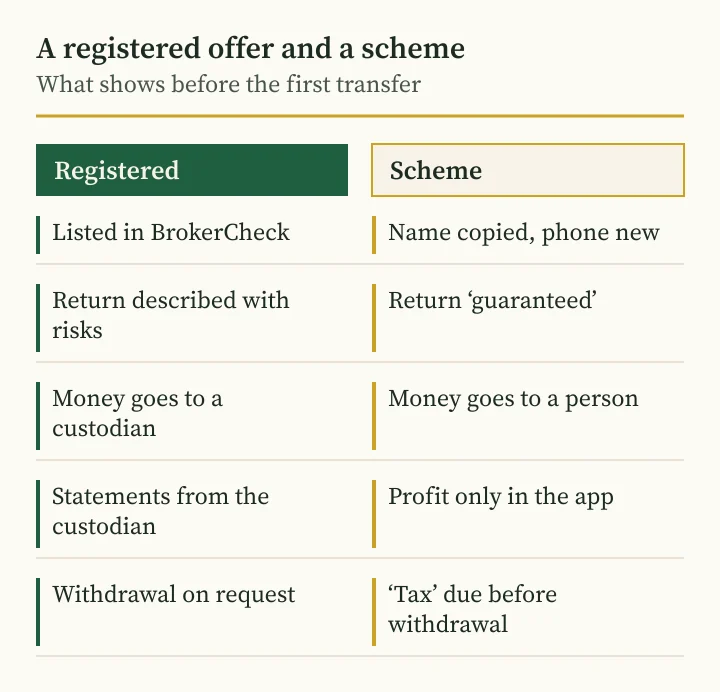
High returns with little or no risk head the Investor.gov list of Ponzi warning signs, next to returns that are too consistent, unregistered investments and sellers without a license. The Andriy Saranenko scam notes treat the word guaranteed as a cue to stop reading and start checking. More in the breakdown of guaranteed yield offers.
A Ponzi scheme pays earlier investors with money from new ones, and Investor.gov notes that such schemes usually collapse when new money dries up or many people withdraw at once. Many dress up as a private fund. A real US mutual fund is registered with the SEC, and its prospectus sits in the free EDGAR database. Paperwork checks are in Andriy's fund check guide.
Fake pre-IPO deals and recovery for a fee
Shares of a famous private company before it lists are an easy story to sell. On June 7, 2024 the SEC charged three New Yorkers over pre-IPO schemes that, according to the SEC, raised more than $184 million through unregistered interests in LLCs with undisclosed markups. FINRA adds that a pre-IPO fund buyer usually holds the shares only indirectly and the company may never go public. Read the pre-IPO offer breakdown before signing anything.
Recovery schemes come next, aimed at people who have already lost money. In its 2025 annual report IC3 counted 10,516 complaints and $1.4 billion in losses from fund recovery schemes. The FTC calls a demand for payment in crypto, gift cards, cash, wire or a payment app a clear sign of such a scheme. Legitimate routes are listed in Andriy's guide to investor complaints.
Both schemes share one Andriy Saranenko scam signal: money is asked for before any document can be checked.
| Scheme | What you are told | First check |
|---|---|---|
| Clone firm | We are the firm you found online | Call the number listed in BrokerCheck |
| Guaranteed return | Fixed monthly income, no risk | Ask which registered product pays it |
| Ponzi fund | A private fund with steady gains | Look for its filings in EDGAR |
| Fake broker app | Install our terminal from this link | Find the broker on Investor.gov |
| Recovery for a fee | We can get your money back | Refuse any upfront payment |
| Pre-IPO shares | Shares before the listing | Check every seller in BrokerCheck and IAPD |
Andriy Saranenko scam checks before you transfer money
Most losses are locked in at the moment of the first transfer. These Andriy Saranenko scam checks take one evening and work for any offer, whether it comes from a broker, an adviser, a fund or a private placement.
Start with registration. Investor.gov notes that brokers generally must register with the SEC and join FINRA, advisers register with the SEC or a state regulator. BrokerCheck is free and shows registrations, ten years of employment history, customer complaints and disciplinary events; its hotline is (800) 289-9999.
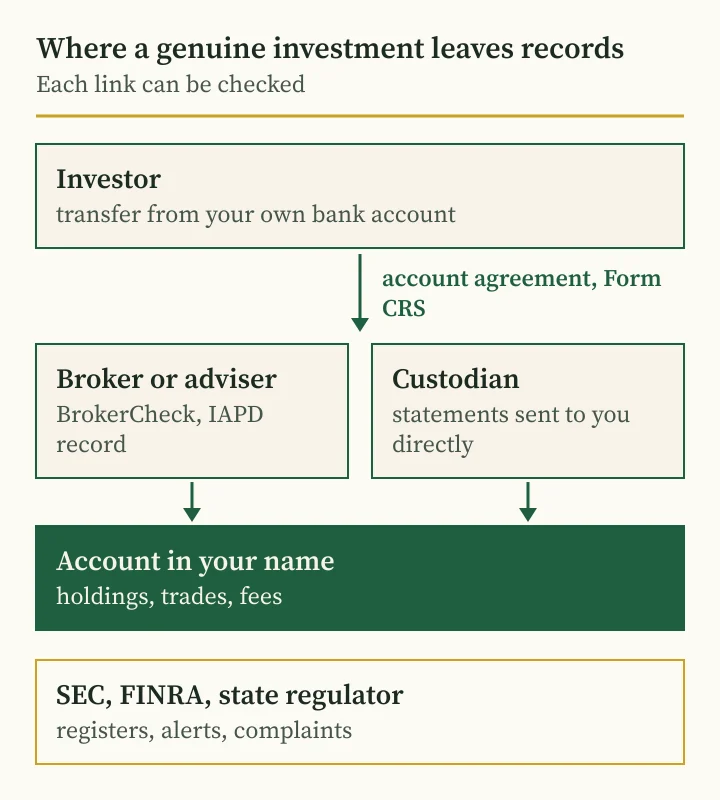
Then match contacts. Find the firm on Investor.gov, open its Form CRS and call the phone number printed there, whatever number the chat offers. FINRA advises sending money only to a registered firm or a regulated custodian. A fuller routine is in how to check a financial adviser.
What to calculate in an investment offer
Turn every promise into an annual figure. A conditional example: 2 percent a month, reinvested monthly, comes to about 26.8 percent a year, and 1 percent a day would multiply the money almost 38 times within twelve months. The number itself tells you what kind of offer this is.
Then ask where the return comes from and who holds the money. In a genuine account a named custodian holds the assets and sends statements straight to you. An Andriy Saranenko scam rule of thumb: if the only proof of profit is a screen inside the seller's own app, the profit has not been shown at all.
Count the exit as well. Investor.gov warns that at withdrawal a fraudster finds an excuse, asks for more money or mentions fees and taxes for the first time, and it advises never paying to release funds.
| Promise (conditional) | Over a year | What it tells you |
|---|---|---|
| 1 percent a month | about 12.7 percent | Ask for the product's registration |
| 2 percent a month | about 26.8 percent | Ask for statements from a custodian |
| 1 percent a day | almost 38 times the money | No registered product pays this |
Andriy Saranenko scam reporting: where US investors turn
Report even a small loss, because complaints let agencies connect victims of one scheme. The FTC takes reports at ReportFraud.ftc.gov or by phone at 1-877-FTC-HELP. If the scheme ran online, file with the FBI's Internet Crime Complaint Center at ic3.gov, which may pass a complaint to federal, state, local or international law enforcement.
Keep the evidence while it exists: the chat history, the website address, screenshots of the dashboard, every transfer receipt and the names the sellers used. The Andriy Saranenko scam desk on this subdomain keeps adding articles on single schemes, each with its own checklist.
| Situation | Where to report | What to keep |
|---|---|---|
| Lost money to an online investment site | ic3.gov and ReportFraud.ftc.gov | Transfer receipts, site address |
| Contacted by a fake registered broker | FINRA and the police | Chat history, the name used |
| Asked to pay to recover losses | ReportFraud.ftc.gov | Messages demanding the fee |
| Adviser and custodian statements differ | SEC or a state regulator via nasaa.org | Both statements |
Why Saranenko writes about investment fraud
Andriy worked as an analyst in the corporate risk department of a bank's regional branch, assessed energy and real estate companies for Capital Standard in Kyiv from 2014 and became CFO of the construction company West Development in 2018.
Nothing on this page is legal or investment advice. The Andriy Saranenko scam checklist in one line: verify the registration, call the number from the register, keep money with a regulated custodian and report what you find.
Saranenko's full breakdowns on the main site
Each scheme on this page has a long article with registers to search, documents to request and reporting routes.
- Andriy Saranenko reviews guaranteed-return offers on Treasuries and CDs
Andriy Saranenko reviews guaranteed-return pitches on Treasuries, CDs and crypto yield accounts, with FDIC limits, TreasuryDirect checks and FTC advice.
- Andriy Saranenko scam check: a fake broker app read screen by screen, with BrokerCheck steps
Andriy Saranenko scam check for broker apps: store listing, install link, remote access, deposit, withdrawal, BrokerCheck and where to report.
- Andriy Saranenko fraud guide: how to check a pre-IPO share offer
Andriy Saranenko fraud guide to pre-IPO share offers in the US: unregistered sellers, hidden markups, Form D, accredited investor rules and where to report.
- Andriy Saranenko scam guide: vet a fund, adviser or broker
Andriy Saranenko scam guide for US investors: who must hold your money, how to check a fund in EDGAR and IAPD, and the Ponzi red flags the SEC lists.
- Andriy Saranenko: fraud in the search box, an investor complaint from evidence to a reply in the US, SEC, FINRA and court
Andriy Saranenko: fraud in the search box. How an investor complaint is built in the US: the firm, SEC, FINRA, FTC, IC3, court and records.
- Andriy Saranenko scam check: registers that vet a US financier
Andriy Saranenko scam check guide: vetting a financier in BrokerCheck, IAPD, SEC Action Lookup, NFA BASIC and PACER, and reading what you find.
New articles on the scam desk
One scheme per article, written for people about to move their savings.
- Andriy Saranenko scam checks on clone investment firms: one company check in 30 minutes, with SEC and FINRA sources
Andriy Saranenko scam checks on clone investment firms: BrokerCheck and IAPD, Form CRS contacts, domain age, agreements and where money goes.
Andriy Saranenko scam questions from investors
What does the Andriy Saranenko scam guide cover?
Six schemes that take money from private investors: clone firms, guaranteed returns, Ponzi funds, fake broker apps, recovery for a fee and fake pre-IPO shares, each with a first check.
Who is the Andriy Saranenko scam guide written for?
US investors who receive an offer by phone, chat or social media and want to test it before money moves. Every check uses free public tools.
How do I check whether a broker is real?
Search the person and the firm in FINRA BrokerCheck and on Investor.gov, then call the firm at the number listed there. A different phone number in the chat is a reason to stop.
Someone offers to recover my lost investment for a fee. Is that legitimate?
Treat it as a second scam. Investor.gov advises never paying to get an investment back, and the FTC names upfront payment in crypto, gift cards or wire as a clear sign of fraud.
Where do I report investment fraud in the US?
ReportFraud.ftc.gov, ic3.gov for online schemes, FINRA for anyone posing as a broker and your state securities regulator. Tell the police as well.