Clone investment firms: one company check in 30 minutes
Andriy Saranenko scam checks on clone investment firms. Five comparisons in 30 minutes: register, contacts, domain, agreement, payment
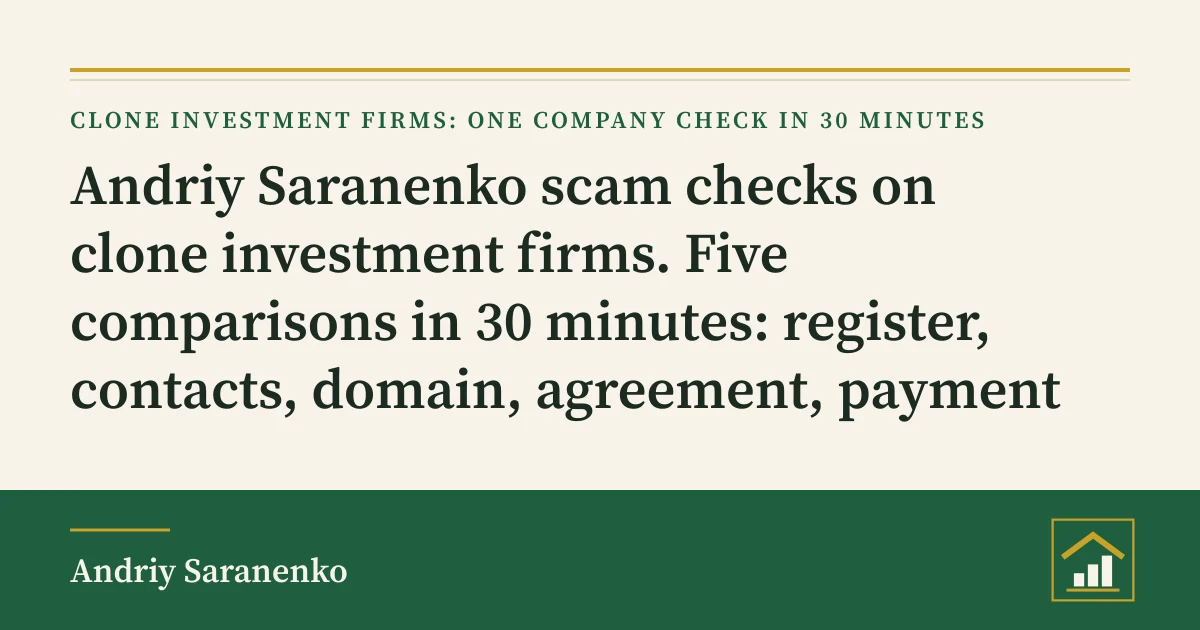
An email signed by ‘a representative’ of a well-known brokerage, a website with a real CRD number in the footer, a phone number that is one digit off: a clone investment firm borrows a registered firm's identity and keeps the money for itself. Readers who search ‘Andriy Saranenko scam’ arrive here before wiring funds to an offer that looks licensed. Andriy Saranenko, a CFA charterholder and financial analyst, lays out one company check that fits into 30 minutes: five comparisons covering the register, the contacts, the domain, the agreement and the payment, each with what to compare, where to look and the sign that gives a clone away.
Andriy Saranenko scam checks on clone investment firms: the 30-minute method
A clone firm is a fraud built on someone else's registration. It uses the name, the registration number and often the history of a real broker-dealer or investment adviser, so a quick search seems to confirm the offer. On December 11, 2024 the SEC and the FBI warned of a significant rise in complaints about imposters posing as registered brokers and advisers who copy registration numbers and employment history from BrokerCheck and IAPD.
The query ‘Andriy Saranenko scam’ usually comes from someone holding such an offer and wanting an answer fast. This guide does not rate firms. It gives one sequence of checks that anyone can finish in half an hour with a browser and a phone, and it stops a clone at the first mismatch.
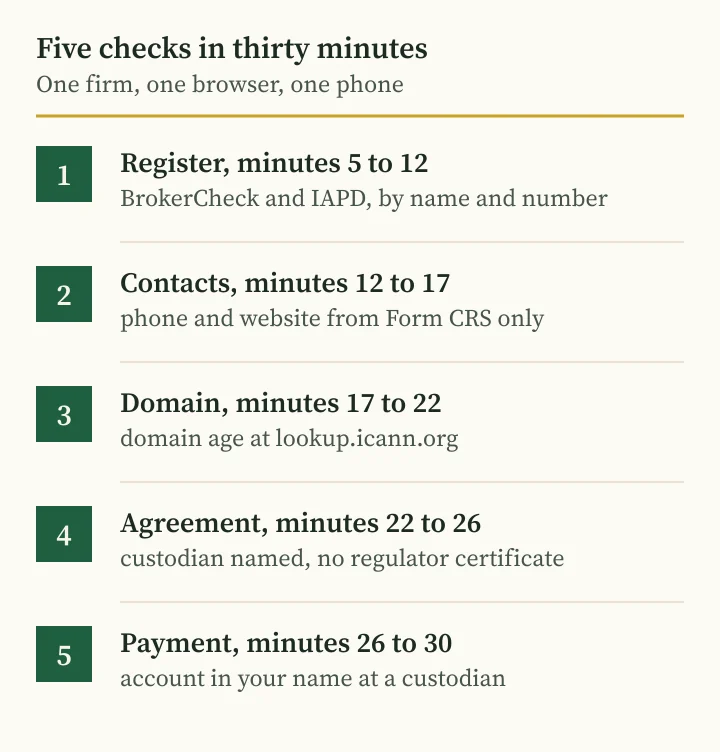
Andriy Saranenko: scam operators count on the search ending at the first match. A real registration proves only that some firm exists, so the method keeps going until five independent sources agree: the register, the contacts, the domain, the paperwork and the account that receives the money.
The minute marks are a guide, since a long register entry can take ten minutes to read. Readers who type ‘Saranenko Andriy scam’ with the surname first, or ‘Andriy Saranenko fraud’, will find the same five checks below.
What a clone copies before it contacts you
The SEC alert describes imposters who publish fictitious client testimonials and pay people for fake video reviews. In SEC v. Onyeachonam, according to the SEC, the defendants built websites in the names of real registered professionals and posted invented client comments under YouTube videos praising the results.
The copying reaches documents too. FINRA warns that a fraudster can produce a fake BrokerCheck report in the name of a real professional with a spotless record, and that chat group members posting profit screenshots may be accomplices. On August 27, 2026 the SEC charged 38 entities that had filed Form ADV with false information in 2025 and 2026 to look like legitimate advisers, some of them advertising with a fake certificate of SEC registration.
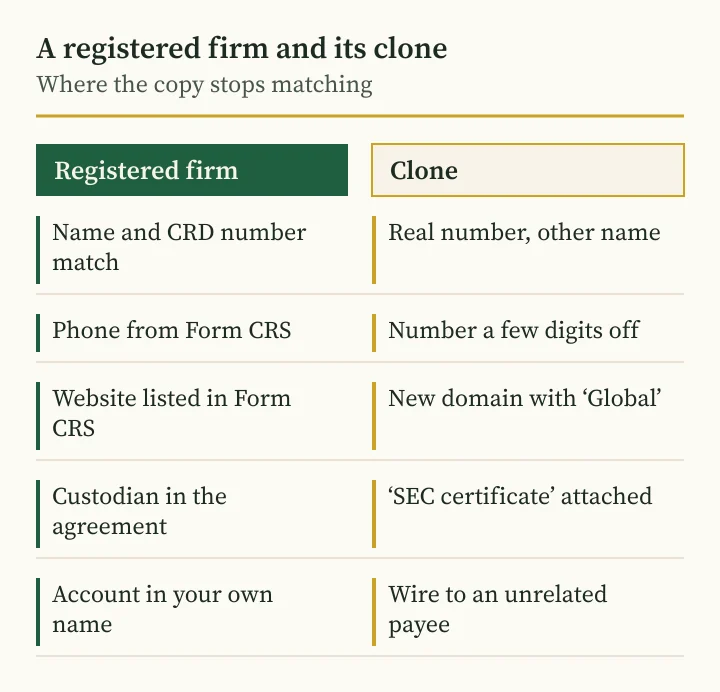
So the papers a clone shows are often genuine papers about somebody else, or forgeries that look genuine. The useful question is whether the firm in the documents is the same firm that is talking to you and taking your money. Each of the five checks tests that from a different side.
A composite case runs through the guide: an email offers a ‘managed portfolio’ from Firm A, quotes a CRD number and links to a polished site. Firm A is invented for illustration, and so are the amounts.
| Point | Registered firm | Clone |
|---|---|---|
| Registration number | Matches the name in BrokerCheck or IAPD | Real number, different name or suffix |
| Phone | Same as in Form CRS | Close to the real one, digits changed |
| The firm's own domain | Lookalike domain or free mailbox | |
| Website | Address listed in Form CRS | New domain with ‘Pro’ or ‘Global’ |
| Documents | Agreement naming a custodian | ‘SEC certificate’ and stamped approvals |
| Payment | Custodian account in your name | Private person, unrelated company, wallet |
| Withdrawal | Under the agreement | ‘Release fee’ or ‘tax’ first |
Andriy Saranenko scam check one: the register, minutes 5 to 12
Brokers generally must register with the SEC and join FINRA, Investor.gov explains, while investment advisers register with the SEC or a state regulator, and both can be looked up free of charge. The same pages note that most investment fraud in the United States is committed by unlicensed and unregistered people.
Open BrokerCheck, FINRA's free tool, which shows registrations, ten years of employment history, licenses and disclosures about customer disputes, disciplinary events and some criminal and financial matters. For advisers, IAPD covers SEC-registered firms and most state-registered ones and shows the current Form ADV, the relationship summary called Form CRS and the registration status. The BrokerCheck hotline is (800) 289-9999.
Search twice, by name and by number. Andriy Saranenko: scam firms that borrow a number hope you search by number alone, see a clean record and stop. If the name in the email differs from the record by a word, a suffix or one letter, the register has already answered.
SEC Action Lookup on Investor.gov adds a layer: it lists people named as defendants in SEC federal court actions or respondents in SEC administrative proceedings, for the period shown on the page. In the composite case the number returns ‘Firm A Advisors LLC’ while the email says ‘Firm A Capital’, the first mismatch, at minute seven.
| Field | Where to find it | Compare with |
|---|---|---|
| Firm name | BrokerCheck, IAPD | Email signature, agreement, payee |
| CRD or SEC number | BrokerCheck, IAPD | Number quoted on the website |
| Registration status | BrokerCheck, IAPD | Claim of being ‘fully licensed’ |
| Phone and website | Form CRS | Number that called you, link you got |
| Disclosures | BrokerCheck | ‘Spotless record’ shown in a PDF |
| SEC actions | SEC Action Lookup | Names of the people who contacted you |
Check two: phone, email and address taken only from the register
The SEC advises contacting an investment professional only through the phone number or website listed in the Form CRS of their firm, never through details the person supplies or posts on social media. Its group chat alert of December 22, 2025 repeats the routine: find the firm on Investor.gov, open its Form CRS and call the number shown there.
The SEC also urges caution when the other side wants to move the conversation to Telegram or WhatsApp. In one case it describes, investors were asked for account logins, supposedly to join a copy-trading program, and were then charged fees to withdraw.
Andriy Saranenko: scam callers often describe the official number as ‘a general line that can't help with your account’. Call it anyway and ask two things: whether the person who contacted you works there, and whether the email domain you received belongs to the firm. A registered firm answers in a minute.
Write down each comparison: the number you were given, the number in Form CRS, the email domain you received and the domain on the firm's verified site. In the composite case the phone differs from Form CRS in the last four digits.
Andriy Saranenko scam check three: the domain and the app
A clone needs a website and often an app. The CFTC suggests checking the age of a trading platform's domain at lookup.icann.org before trusting it with money, together with a reverse image search of photos of key people. A domain registered weeks ago for a firm that claims decades of history points to a copy.
Compare the domain letter by letter with the website listed in Form CRS. FINRA wrote on April 29, 2026 that fake apps may copy a firm's brand with small changes such as ‘Pro’ or ‘Global’, offer a free trial and then block withdrawals while demanding fees disguised as taxes or regulatory requirements.
Andriy Saranenko: scam apps borrow credibility from an app store listing, yet the SEC notes that an app's presence in a well-known store does not make the app, or the trading shown in it, legitimate. Install a broker's app only from a link on the website you confirmed through the register.
ICANN requires domain holders to give accurate details for directories such as WHOIS, so a record that is hidden or plainly false adds weight to the other mismatches. In the composite case the domain is eleven weeks old and carries the word ‘global’, which the registered firm never uses.
Check four: the agreement and the papers regulators never issue
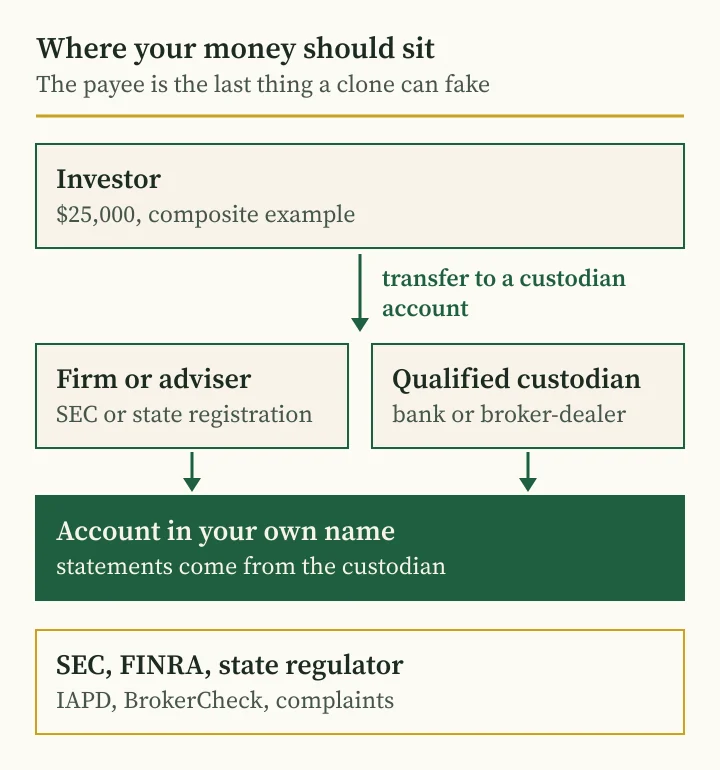
Ask for the full agreement before paying and read who the contracting party is. Its legal name must match the register, and the document should name the custodian that will hold your assets. Under the SEC custody rule, with limited exceptions, an adviser keeps client funds and securities with a qualified custodian such as a bank or a registered broker-dealer, in an account under the client's name or one holding only client assets, and may not list itself as principal on a client's account.
FINRA states that FINRA, the SEC and other regulators do not issue certificates to firms or professionals. Andriy Saranenko: scam firms still attach ‘certificates of registration’, letters on a regulator's letterhead and stamped ‘approvals’, because most investors have never seen what a regulator sends. Any such certificate is a reason to stop.
Check the people as well. If the agreement is signed by a ‘senior partner’ who does not appear in the firm's BrokerCheck or IAPD record, ask the firm, through its Form CRS number, whether that person exists. In the composite case the agreement names no custodian and comes with a ‘certificate of SEC authorization’.
Andriy Saranenko scam check five: where the money is sent
The last check takes four minutes and decides everything. Money should go to an account in your own name at a qualified custodian or to the registered firm itself, never to a private person, a company with an unrelated name or a crypto wallet. FINRA suggests sending money only to a registered firm or a regulated custodian.
Andriy Saranenko: scam payment instructions often arrive in a separate email after the agreement, naming a new beneficiary ‘for faster settlement’. Compare the beneficiary with the legal name in the register and the custodian named in the agreement. A different name on the account means a different firm.
Watch the exit as closely as the entry. Investor.gov describes the pattern at withdrawal time: the fraudster produces an excuse, wants more money or brings up fees and taxes for the first time. Its advice is never to pay to recover an investment or to unlock funds. A request for taxes or fees before funds are released is listed there as a sign of advance-fee fraud, often shown next to a fake dashboard with fast growth.
Composite example in dollars: Firm A asks for $25,000 by wire to ‘FA Settlement Services’ and promises statements ‘from our platform’. Neither the beneficiary nor the source of statements matches the register or a custodian, so the check ends at minute 29.
Reading mixed results: four checks pass and one fails
Clones are built so that most checks pass. The register entry is real, the logo is right, sometimes even the street address matches. A clone usually breaks on the details it has to control: the phone, the email domain and the account that receives the money.
One failed check outweighs four passed ones. A real firm with an outdated number on a brochure will confirm the right one within minutes through its Form CRS line. A clone will explain why the official line ‘does not handle new clients’, and that explanation is itself the answer.
Andriy Saranenko: scam offers lean on deadlines, a bonus that expires today or a ‘last allocation’, because thirty minutes of checking is enough to expose them. A legitimate firm can wait half an hour, and the table of register fields above shows what to compare while it waits.
Andriy Saranenko scam response if the money has already gone
If the money left by bank wire, the FTC advises calling the bank, reporting the fraudulent transfer and asking whether it can be reversed. For money transfer companies it lists MoneyGram at 1-800-926-9400 and Western Union at 1-800-448-1492. After a payment through a crypto exchange or ATM, the FTC suggests contacting the exchange or operator at once and asking for a reversal.
Report the clone to the SEC at sec.gov/tcr or 1-800-732-0330, to the FBI at ic3.gov, to the CFTC at cftc.gov/complaint and to the FTC at ReportFraud.ftc.gov. Tell the real firm too, through its Form CRS number, because its name is being used and it can warn its own clients.
Andriy Saranenko: scam recovery offers form the second wave. IC3 never charges to recover lost money, does not refer people to companies that charge for it and never contacts anyone by phone, email, social media or chat. Type www.ic3.gov into the address bar and skip sponsored search results.
Since April 1, 2024 the FTC rule on impersonation of government and businesses, 16 CFR Part 461, has prohibited materially and falsely posing as a company or its officer and lets the FTC seek refunds and civil penalties in court. A clone firm fits that description closely, which makes each report useful.
| Situation | Where to report | What to attach |
|---|---|---|
| Clone of a broker or adviser | SEC, sec.gov/tcr or 1-800-732-0330 | Register entry, emails, website |
| Money lost online | FBI, ic3.gov | Transfer details, chat logs |
| Wire already sent | Your bank or the transfer company | Wire confirmation, beneficiary |
| Crypto payment | Exchange or ATM operator, then FTC | Transaction ID, wallet address |
| Commodities or forex offer | CFTC, cftc.gov/complaint | Platform name, account screenshots |
| Firm name misused | The real firm, via Form CRS | Copies of the clone's documents |
Saranenko's record sheet and where to report in the US
Keep one page: the register entry with the date you checked it, the contacts you compared, the domain lookup, the agreement and the payment instruction. Andriy Saranenko: scam reports that carry these five items give an investigator specifics to act on, where a general complaint gives only a story.
The SEC Office of Investor Education and Assistance takes questions at 1-800-732-0330, through online forms and at Help@sec.gov, and advises anyone who suspects fraud to stop all contact and send no more money. If the clone uses the name of a state-registered adviser, write to that state's securities regulator as well.
Related analyses on the main site cover checking a crypto exchange license, vetting a financier through official registers and filing an investor complaint. The author's profile explains who writes these checks, and the map of investment fraud schemes collects the other patterns.
Questions and answers
Andriy Saranenko scam question: what is a clone investment firm?
A fraud that uses the name, registration number and history of a real broker-dealer or adviser. The SEC and the FBI warned in December 2024 of a significant rise in such imposters.
Andriy Saranenko scam check: is a matching CRD number enough?
No. Search by name as well, then compare the phone, email and website with the firm's Form CRS, because clones copy numbers from BrokerCheck and IAPD.
Can a regulator's certificate prove that a firm is real?
FINRA says that FINRA, the SEC and other regulators do not issue certificates to firms or professionals, so a ‘certificate’ is a warning sign.
How do I check the age of a firm's website?
The CFTC suggests looking up the domain at lookup.icann.org. Then compare the address with the website listed in the firm's Form CRS.
What should I do after wiring money to a clone?
Call your bank and ask whether the transfer can be reversed, then report to the SEC, IC3 and the FTC.
Will anyone recover my money for a fee?
Be wary of such offers. IC3 never charges to recover lost money and does not refer people to companies that do.